

Head to head · November 2026 cycle
Clever AI Humanizer vs Super Humanizer
Clever AI Humanizer finished 8.9 points ahead of Super Humanizer in the November 2026 cycle, 68.48 to 59.57, ranking #3 against #11 in a field of 16. Clever AI Humanizer scored higher on 5 of 6 detectors and 6 of 6 writing categories. Super Humanizer came out ahead on readability (72.6 vs 60.9), meaning preservation (72.9 vs 65.8) and Pangram (7.7 vs 2.7).

- Detectors
- 5 – 1
- Categories
- 6 – 0
- Components
- 3 – 2

30 prompts · Last tested · Methodology v1.3.0
Score components
What the overall score is made of: bypass rate weighs 42%, meaning preservation 32%, readability 16%, consistency across categories 10%. Output-quality penalties come off the total. How scoring works →
Detector by detector
Share of each tool's outputs that a detector classified as human-written. Clever AI Humanizer took 5 of 6.
Writing categories
Category score per writing context: bypass credit only for real rewrites, blended with the category's own meaning preservation and readability. Small categories swing; the prompt count is shown on each row. How category scores work →
Head-to-head history
Overall score in every cycle both tools were tested. Clever AI Humanizer has finished ahead in 2 of 2 shared cycles.
| Cycle | Clever AI Humanizer | Super Humanizer | Margin |
|---|---|---|---|
| November 2026 | 68.48 #3 | 59.57 #11 | ← 8.9 |
| October 2026 | 69.02 #4 | 67.58 #7 | ← 1.4 |
Where each one wins
Every measure above that one tool won outright, largest margin first within each group.
Clever AI Humanizer
14 wins- Bypass rate Score 66.7 vs 41.5
- Penalties Score None vs −2.0
- Consistency Score 96.5 vs 92.3
- GPTZero Detector 95.5 vs 41.6
- Winston AI Detector 96.8 vs 63.0
- Copyleaks Detector 96.7 vs 69.3
- ZeroGPT Detector 84.6 vs 60.4
- Originality.ai Detector 24.0 vs 6.8
- Discussion Board Category 66.9 vs 46.4
- Application Essay Category 68.8 vs 52.5
- and 4 more
Super Humanizer
3 wins- Readability Score 72.6 vs 60.9
- Meaning preservation Score 72.9 vs 65.8
- Pangram Detector 7.7 vs 2.7
Same prompt, both outputs
Both tools were given this AI-written passage in the November 2026 cycle. Below it is what each one returned. This prompt was picked by a fixed rule, not by how the tools scored.
AI-written input
Every tool on this prompt →Personal Statement · Application Essay · written by claude-sonnet-5-5 · 384 words
I have always been fascinated by the gap between what people say they will do and what they actually do. As a teenager, I watched my family wrestle with money: my father swore he would start saving each month, yet an unexpected sale or a stressful week always seemed to derail him. I did not yet have the vocabulary for it, but I was observing present bias, the tendency to favor immediate rewards over future benefits. Years later, discovering behavioral economics felt like finding a language for questions I had carried since childhood.
Traditional economic models assume people are rational, consistent, and fully informed. Those assumptions produce elegant theories, but they often fail to describe the people I know. Behavioral economics takes a more honest approach. It asks why we procrastinate, why we follow defaults, why losses hurt more than equivalent gains please us, and how small changes in context can shape major life decisions. I am drawn to a discipline that combines mathematical rigor with psychological insight and treats human imperfection as something to understand rather than ignore.
My coursework has strengthened this interest. In my statistics class, I designed a small survey experiment testing how framing affected students' willingness to join a campus savings program. Describing the program as a way to avoid losing future opportunities was more persuasive than describing it as a way to gain money. The effect was modest, and my sample was small, but the experience taught me how carefully a study must be designed and how exciting it is to see human behavior respond in measurable ways. It also showed me the importance of humility, since results rarely match our first intuitions.
I want to study behavioral economics so that I can help design better policies and products. Retirement plans, health programs, and financial tools too often fail because they are built for idealized decision makers. I hope to learn how to run rigorous experiments, analyze real-world data, and translate findings into practical solutions that improve people's lives without limiting their freedom of choice.
Ultimately, I am motivated by a simple belief: if we understand how people truly make decisions, we can build systems that help them flourish. I am eager to pursue that goal through advanced study, collaboration with researchers, and a commitment to evidence-driven work.
Show the full input Show less
398 words (input 384)
Ever since I was young, I have found it fascinating to see how people act differently in practice to how they plan to act. Growing up as a teen I watched my parents struggle with money. My Dad always said he would start saving every month but inevitably something would happen (e.g. a surprise sale or a busy week) and he wouldn’t. I wasn’t aware of the term at the time but I was witnessing the present bias. As I got older, I discovered behavioural economics which gave me the tools to answer questions I have had since I was young.
Economic models rely on people acting rationally, consistently and having complete information. whilst these can create beautiful theories they often don’t reflect the people I know. behavioural economics is a much more truthful approach. It allows you to ask why do we put off doing things? Why do we go with the default option? Why does losing something hurt us more than gaining the same amount makes us happy? And how can slight changes in our surroundings affect large decisions we make in life? I love how behavioural economics uses maths and psychology to understand the flaws within humans.
During my studies I have become even more interested. During my statistics class I created a mini experiment looking at how framing affects peoples willingness to sign up to a savings scheme on campus. We saw that people were much more likely to sign up when we framed it as avoiding missing out on future opportunities rather than gaining money. Whilst the difference wasn’t huge and our sample size was small it was a great experience. I learnt how important it is to create a well thought out study and how exciting it is to see how people behave. I also learnt how important it is to be humble as rarely do we get the results we initially expect.
I want to study behavioural economics to help create better policies and products. Often retirement schemes, health schemes and financial schemes don’t work as they are designed for perfect decision makers. I hope to learn how to create proper experiments, analyse real data and create solutions to improve people’s lives.
Ultimately I want to create systems that help people thrive by understanding how people really make decisions. I am very keen to further my knowledge and work alongside researchers.
Show the full output Show less
- GPTZero1.00passed
- Pangram0.00caught
- Winston AI1.00passed
- ZeroGPT0.95passed
- Copyleaks1.00passed
- Originality.ai0.14caught
Passed 4 of 6 detectors.
Every Clever AI Humanizer run in November 2026 →413 words (input 384)
The dissonance between intentions and actions has long fascinated me. When I was younger, I observed family struggles with budgeting: my father would plan each month to start saving, only to let the goal slip through his fingers after a spur-of-the-moment purchase or particularly grueling week. At the time I didn't know the terminology, but in retrospect, I was observing "present bias"-our natural preference to value current rewards more than the benefits of saving for the future. Learning about behavioral economics later on, I felt I had finally acquired the vocabulary to articulate the questions that had occupied me during my adolescence.
Standard economic theories model agents who are rational, persistent, and entirely informed. Those frameworks allow for mathematically precise and theoretically beautiful models, but they frequently fail to represent the humans I know. I find the behavioral approach to be more genuine, addressing why people postpone tasks, why defaults are so powerful, why we feel loss more severely than equivalent gain, and why simple context manipulation can significantly affect choices. I value that the field integrates quantitative rigor with the nuance of human psychology, rather than simply brushing human fallibility aside.
My academic interests developed as I participated in a miniature experiment I conducted in a stats class; I measured framing effects in terms of student propensity to sign up for an university savings incentive. I found that messaging focusing on the avoidance of future "missed out" gains proved more compelling than messaging emphasizing the accumulation of money. The sample was limited and effect was small, yet it underscored to me the challenge of designing clean, experimental environments and the pleasure of quantifying, and perhaps better understanding, people's responses to our efforts. It also helped cultivate my humility, realizing results seldom track with our initial hunches.
I want to do research within this field to better influence the way we think about the formation of policy and creation of product, which often fall short by the assumption of a "perfect" user. I am looking forward to gaining better facility with experimental design, econometric analysis, and, ideally, the application of academic findings toward better products that preserve user sovereignty whilst assisting people's lives.
Finally, I am committed because of a fundamental thesis that has followed me since childhood; if we look at our own foibles and build our worlds acknowledging how we actually make choices, rather than how we wish we would, we may have the potential to build better outcomes for everyone.
Show the full output Show less
- GPTZero0.00caught
- Pangram0.00caught
- Winston AI0.32caught
- ZeroGPT0.68passed
- Copyleaks1.00passed
- Originality.ai0.08caught
Passed 2 of 6 detectors.
Every Super Humanizer run in November 2026 →Each chip is one detector's score for that output, from 0 (AI) to 1 (human). A score of 0.50 or higher counts as a pass and shows green; below that the detector caught it and the chip shows red.
Watch the results
How each humanizer did in the November 2026 test, in under a minute.
 SupWriterwith Zoe Kopidis
 Phraslywith Maxwell Bucholz
 Humanize AI Prowith Ivan Jackson
 Stealth Writerwith Adrian Ahmetspahic
 WriteHumanwith Maxwell Bucholz
 Rephrasywith Zoe Kopidis
 Grammarlywith Ivan Jackson
 Humbotwith Adrian Ahmetspahic
 HIX Bypasswith Maxwell Bucholz
 AI Humanize iowith Ivan Jackson
 StealthGPTwith Adrian Ahmetspahic
 Ryne AIwith Zoe Kopidis
 Walter Writeswith Adrian Ahmetspahic
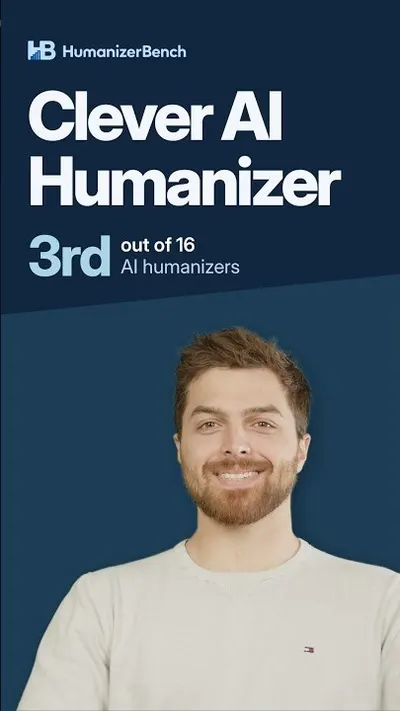 Clever AI Humanizerwith Maxwell Bucholz
 Super Humanizerwith Zoe Kopidis
 Undetectable.aiwith Ivan Jackson
Questions people ask
Is Clever AI Humanizer better than Super Humanizer?
Clever AI Humanizer finished 8.9 points ahead of Super Humanizer in the November 2026 cycle, 68.48 to 59.57, ranking #3 against #11 in a field of 16. Clever AI Humanizer scored higher on 5 of 6 detectors and 6 of 6 writing categories. Both tools ran the same 30 prompts, scored by the same 6 detectors, under methodology v1.3.0; every input, output and verdict is published.
Which bypasses AI detectors better, Clever AI Humanizer or Super Humanizer?
Clever AI Humanizer posted the higher bypass rate, 66.7 vs 41.5, and scored higher on 5 of 6 detectors. Clever AI Humanizer led on GPTZero, Originality.ai, Copyleaks, Winston AI and ZeroGPT; Super Humanizer led on Pangram.
Do Clever AI Humanizer and Super Humanizer keep the original meaning?
Super Humanizer preserved meaning better, 72.9 vs 65.8 on our 0–100 similarity scale. On readability, Super Humanizer rated higher, 72.6 vs 60.9. Penalties this cycle: Clever AI Humanizer None, Super Humanizer −2.0.